
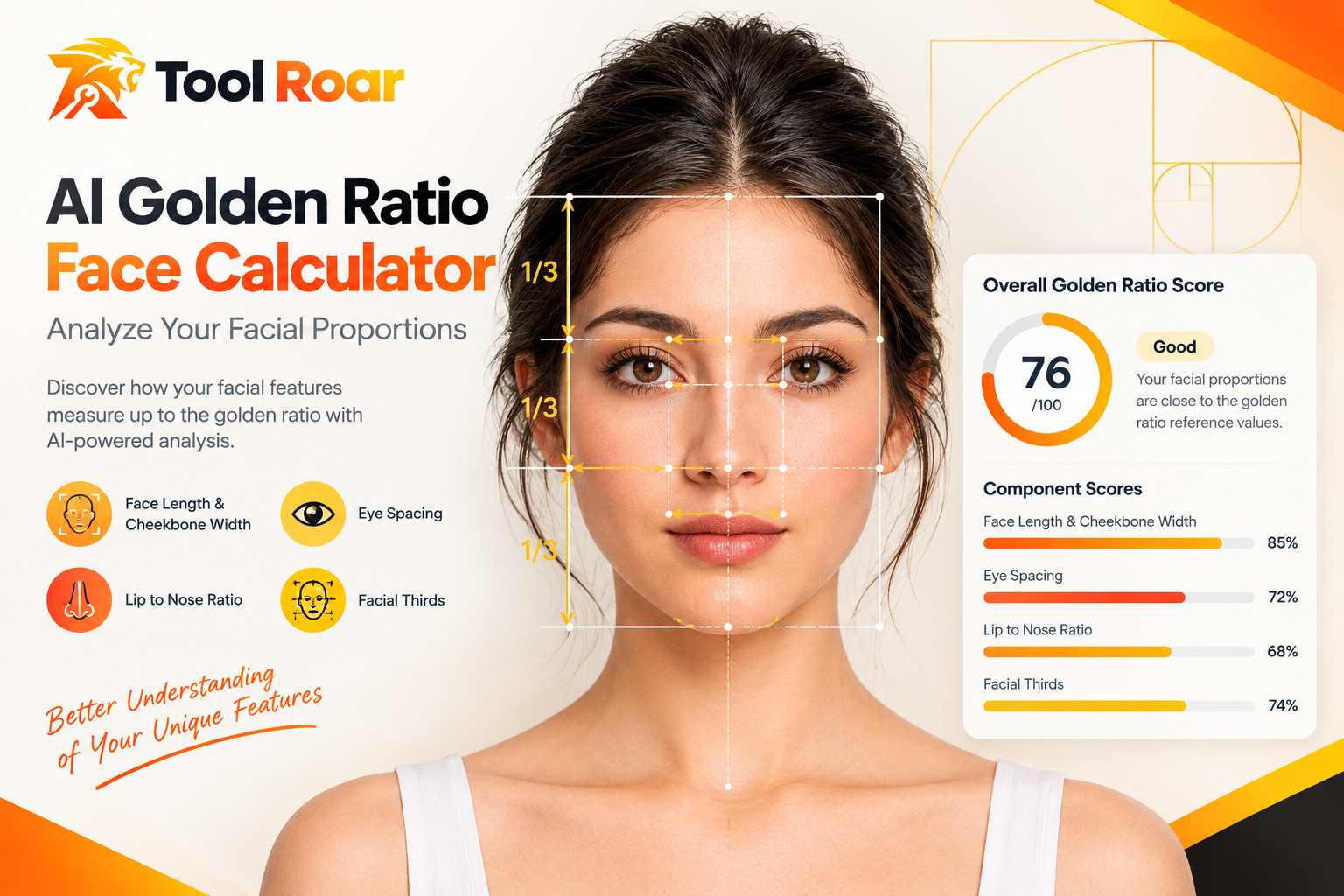
AI Golden Ratio Face Calculator
Analyze your facial symmetry and proportions against the classical Golden Ratio (φ = 1.618) and neoclassical canons.
Drag & drop or tap to select from gallery
Initializing facial detection...
Have you ever wondered how your facial proportions compare with the golden ratio? From the spacing between the eyes to the relationship between the nose and lips, facial proportions have long been discussed in art, photography, design, and beauty.
An AI Golden Ratio Face Calculator makes it easier to explore these measurements without manually measuring your face with a ruler. By analyzing a facial photograph, an online face calculator can estimate selected facial proportions and present them in an understandable score.
Our AI Golden Ratio Face Calculator is designed to help you explore these proportions through a simple photo-based analysis. You can upload a front-facing photo, review the calculated measurements, and learn how different parts of your face relate to one another.
However, it is important to understand that the golden ratio is a mathematical concept, not a universal formula for beauty. Your results are best treated as an interesting facial-proportion analysis rather than a definitive judgment of your appearance.
Table of Contents
What Is the Golden Ratio?
The golden ratio is a mathematical proportion commonly represented by the Greek letter phi (φ). Its approximate value is 1.618.
This ratio describes a relationship between two parts of a whole. When a line is divided according to the golden ratio, the relationship between the entire length and the larger part is approximately the same as the relationship between the larger part and the smaller part.
The concept appears in mathematics, geometry, architecture, art, and design. It has also been applied to discussions about facial proportions.
In facial analysis, the golden ratio is often used as a reference for exploring relationships between facial features. These may include overall face length, cheekbone width, eye spacing, nose width, and mouth width.
Some online calculators compare selected measurements with predefined reference proportions. The resulting score provides a simplified way to understand how closely the measured features align with those particular targets.
It does not mean that every attractive face follows the same mathematical pattern.
What Is an AI Golden Ratio Face Calculator?
An AI Golden Ratio Face Calculator is an online tool that analyzes a photograph to estimate relationships between selected facial features.
Instead of requiring you to measure every feature manually, the tool uses facial analysis technology to identify important points around the eyes, nose, mouth, and face outline. These points can then be used to estimate distances and ratios.
The AI Golden Ratio Face Calculator available through Tool Roar combines several facial-proportion measurements into an overall score.
Its analysis includes four main components:
- Face length and cheekbone width: Examines the relationship between overall facial length and cheekbone width.
- Eye spacing: Compares the distance between the inner eyes with eye width.
- Lip-to-nose ratio: Examines the relationship between mouth width and nose width.
- Facial thirds: Evaluates selected vertical proportions across the upper, middle, and lower face.
Each component contributes to the final result according to the calculator’s scoring formula.
The purpose is to make selected facial measurements easier to explore without turning the process into a complicated manual exercise.
How to Use the AI Golden Ratio Face Calculator
You can use the calculator in a few simple steps.
Step 1: Open the Calculator
Visit the AI Golden Ratio Face Calculator on Tool Roar. Open the tool interface and prepare a suitable photograph for analysis.
Step 2: Upload a Clear Face Photo
Choose a photograph in which your face is clearly visible. A front-facing portrait is generally a good starting point because it makes the relative positions of facial features easier to assess.
For better results, avoid photographs with heavy shadows, extreme angles, strong filters, or objects covering your face.
Step 3: Start the Analysis
Run the calculator and allow the facial-analysis process to complete. The tool examines selected facial landmarks and uses their positions to estimate the relevant proportions.
Step 4: Review Your Results
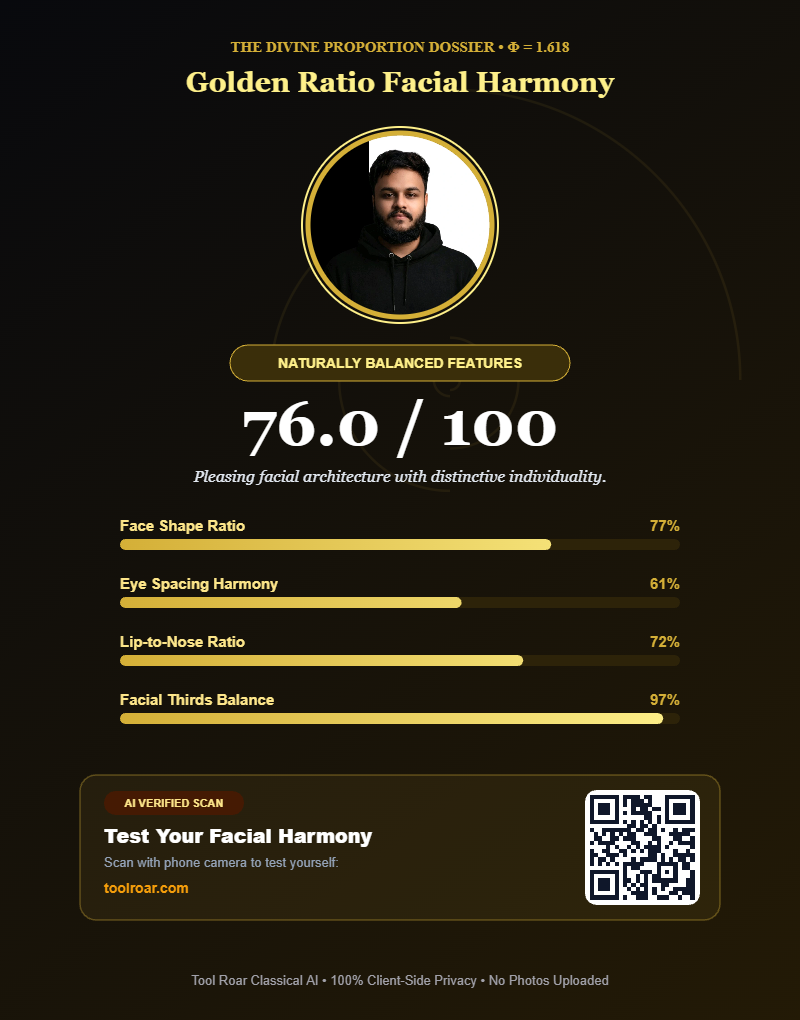
Once the analysis finishes, review the overall score and the component measurements shown by the calculator.
Look at the individual components rather than focusing exclusively on the final number. They can help you understand which facial relationships the tool is measuring.
Step 5: Interpret the Score Carefully
Treat the result as a reference based on the calculator’s formulas. It is not a medical assessment, an objective attractiveness ranking, or a scientifically established measure of personal beauty.
For a more meaningful comparison, you can also consider how changes in lighting, camera angle, and facial positioning affect the measurements.
After that you can simply save the result and can get the result as follows:
How Does the Tool Calculate Your Facial Proportions?
The Tool Roar calculator combines four components into an overall score using a weighted formula. Each component contributes a different amount to the final result.
1. Face Length and Cheekbone Width
This measurement compares the vertical length of the face with its width around the cheekbones.
The relationship between facial length and width is one way to describe general facial proportions. Different relationships can produce different overall face shapes.
The measurement is an estimate based on the visible features in the uploaded photograph. Camera perspective and head positioning may influence it.
2. Eye Spacing
The calculator examines the relationship between the space between the inner corners of the eyes and eye width.
Eye spacing is frequently discussed in facial-proportion analysis because it describes the relative positioning of facial features.
However, there is no single eye-spacing measurement that defines beauty for every individual.
3. Lip-to-Nose Ratio
This component compares the width of the mouth with the width of the nose.
It provides a numerical description of the relationship between two central facial features. The calculator uses this measurement as one component of its overall score rather than treating it as a standalone beauty test.
4. Facial Thirds
Facial thirds divide the face vertically into approximate upper, middle, and lower sections.
These sections are commonly discussed in traditional facial analysis. Their apparent proportions can vary between individuals and may be affected by the visible hairline, chin position, and the angle of the photograph.
The calculator uses selected facial-third measurements as part of its proportion analysis.
How the Four Components Affect Your Score
The Tool Roar calculator uses the following weights:
| Measurement | Contribution |
|---|---|
| Face length and cheekbone width | 35% |
| Eye spacing | 25% |
| Lip-to-nose ratio | 20% |
| Facial thirds | 20% |
| Total | 100% |
These weights describe the calculator’s own scoring formula. They are not scientific weights established by a universal facial-beauty standard.
The overall result combines the four components into one convenient score. For this reason, two people with similar overall scores may still have different individual measurements.
What Does Your Golden Ratio Face Score Mean?
Your score should be understood in the context of the measurements and reference values used by the calculator.
A higher score indicates a closer match to the calculator’s selected targets according to its scoring rules. A lower score indicates a greater difference from those targets.
Neither result establishes how attractive, healthy, or unique a person is.
Facial appearance is influenced by many factors, including facial structure, skin, expression, cultural preferences, age, and individual perception. A few geometric measurements cannot capture all these dimensions.
Rather than asking whether your face is perfect, use the score to understand the proportions being measured and how they relate to the calculator’s chosen reference points.
Does the Golden Ratio Determine Facial Beauty?
No. The golden ratio does not provide a universally accepted formula for determining facial beauty.
Although the idea is popular in online beauty discussions, the scientific evidence is more complicated than many social media posts suggest.
A systematic review published in The Journal of Prosthetic Dentistry examined research on the golden proportion in natural facial aesthetics. Its findings did not establish a consistent association between the golden ratio and facial evaluation scores across ethnicities.
A 2024 review in Maxillofacial Plastic and Reconstructive Surgery also concluded that convincing evidence does not support the golden ratio as a universal standard for ideal facial proportions.
These findings do not make facial measurements useless. They mean that measurements should be interpreted for what they are: descriptions of selected geometric relationships, rather than definitive rules about attractiveness.
The AI Golden Ratio Face Calculator is intended for exploration and educational use. Its score should not be treated as a scientifically validated beauty rating.
Tips for Getting a More Consistent Analysis
The quality of your photograph can affect the measurements produced by a facial-analysis tool.
For a more consistent result, keep these tips in mind:
- Face the camera directly. Avoid strong side angles or tilting your head.
- Use even lighting. Harsh shadows can make facial boundaries harder to identify.
- Keep your face unobstructed. Hair, hands, sunglasses, and other objects can hide important landmarks.
- Choose a natural photograph. Avoid filters or edits that alter the apparent position or size of facial features.
- Keep your expression relaxed. A neutral expression can make it easier to compare measurements across photographs.
- Use a clear image. Blurry or heavily compressed photographs can reduce the reliability of landmark detection.
Even when you follow these recommendations, the calculator produces estimates rather than exact clinical measurements.
Who Can Use an AI Golden Ratio Face Calculator?
An AI Golden Ratio Face Calculator may be useful for people interested in facial proportions, beauty technology, photography, portrait composition, or AI-based image analysis.
For example, you might use it to learn about the geometry of facial features, explore how proportions are described, or see how a photo-based analysis tool presents its measurements.
It may also be useful for students and curious users who want a practical introduction to facial landmarks and ratios.
The tool is not intended for medical diagnosis, professional surgical planning, or determining whether someone meets an objective standard of beauty.
Frequently Asked Questions
Is the AI Golden Ratio Face Calculator free?
Check the current Tool Roar calculator page for its availability and any usage restrictions. The calculator’s interface will provide the relevant information about using the tool.
What is the golden ratio in facial analysis?
The golden ratio is a mathematical proportion of approximately 1.618. In facial analysis, it is used as a reference for discussing relationships between selected facial measurements. It is not a universal formula for attractiveness.
How accurate is an AI Golden Ratio Face Calculator?
Accuracy depends on factors such as image quality, landmark detection, camera perspective, and the formulas used by the tool. The resulting score should be treated as an estimate rather than a clinically validated measurement of beauty.
Can I calculate my facial golden ratio from a selfie?
Yes, a clear, front-facing selfie can be a convenient starting point. Good lighting, minimal head tilt, and unobstructed facial features can help the tool estimate measurements more consistently.
Does a higher golden ratio score mean I am more attractive?
No. A higher score means the measurements align more closely with the calculator’s predefined targets. It does not establish a person’s attractiveness or value.
Can facial proportions change the result?
Yes. Camera angle, head position, lighting, and image quality can affect the landmarks detected in a photograph. Different photographs of the same person may therefore produce different estimates.
Is the golden ratio scientifically proven to define a perfect face?
No. Current research does not establish the golden ratio as a universal standard of facial beauty. Human attractiveness is complex and cannot be reduced to one mathematical proportion.
Is this tool a medical or professional facial assessment?
No. It is intended for general informational and educational exploration. Its results should not be used for medical diagnosis, treatment decisions, or surgical planning.
Explore Your Facial Proportions With Tool Roar
Curious about how facial proportions are measured? Try the AI Golden Ratio Face Calculator on Tool Roar to explore the relationship between face length, cheekbone width, eye spacing, nose width, mouth width, and facial thirds.
Upload a suitable photograph, review the measurements, and use the results as an opportunity to learn more about facial geometry.
Remember that the golden ratio is only one way of describing proportions. There is no single mathematical score that defines a perfect face, and individual differences are a natural part of human appearance.
Check out our other Beauty Tools.