
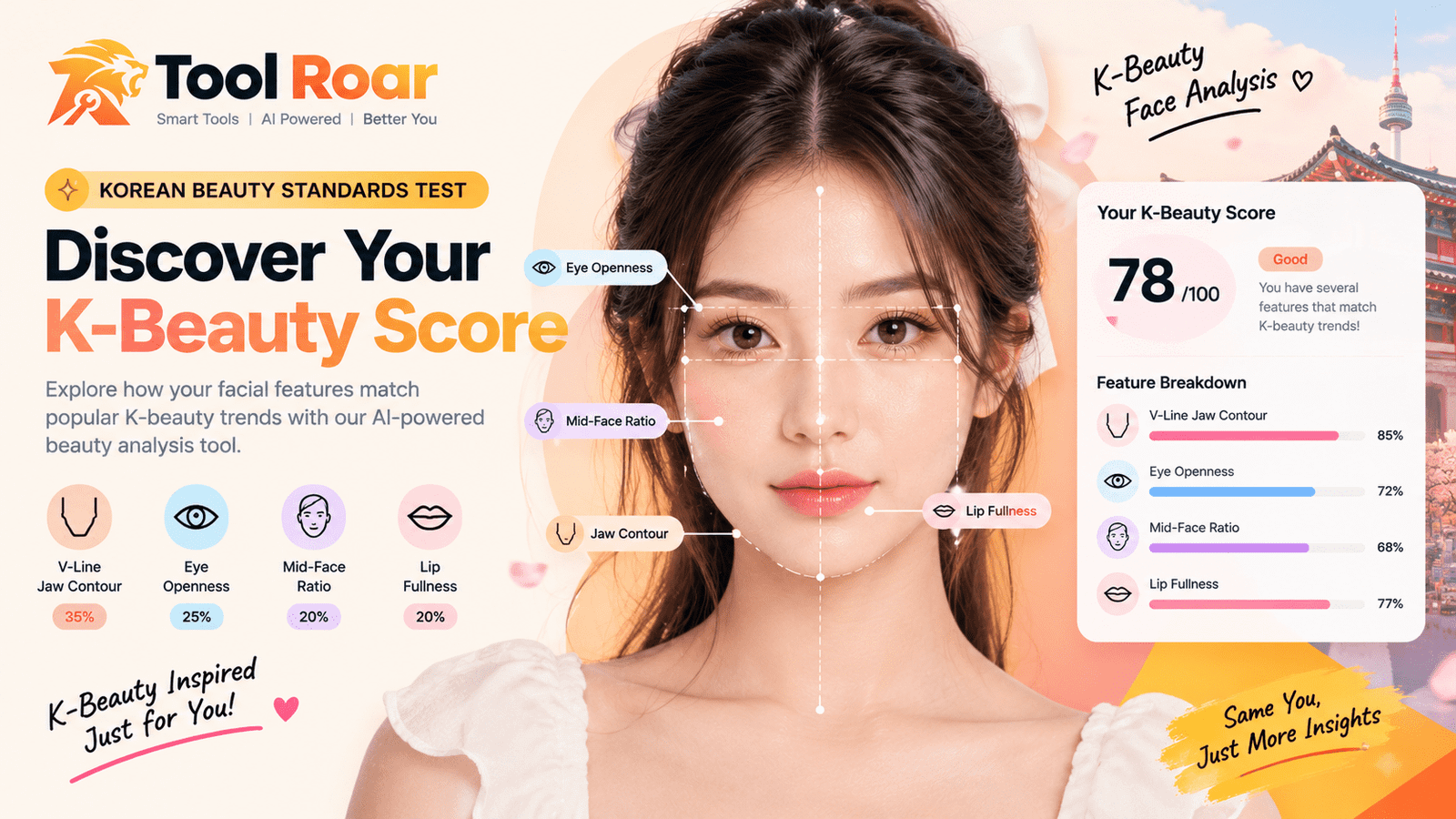
Korean Beauty Standards Test
Test your features against K-Pop Idol & Ulzzang aesthetics: V-Line jawline, Doe eyes, compact youthful midface, and cherry lips.
Clear front-facing selfie or headshot
Scanning V-Line contour & Ulzzang ratios...
Korean beauty trends have gained worldwide attention through K-dramas, K-pop, skincare routines, and the global popularity of Korean cosmetics. From a softly contoured V-line jaw to bright-looking eyes and balanced facial proportions, different features often appear in discussions about K-beauty aesthetics. But how do these trends translate into a facial analysis score?
The Korean Beauty Standards Test on Tool Roar offers a simple way to explore selected facial features inspired by commonly discussed K-beauty trends. Using a photo, the tool evaluates four areas: V-line jaw contour, eye openness, mid-face ratio, and lip fullness. It then combines these factors into an overall score based on its built-in scoring model.
This test is designed for curiosity and entertainment. It does not determine whether someone is beautiful, measure personal worth, or represent an official Korean beauty standard. Beauty preferences vary between individuals, cultures, and trends, so the result is best treated as an interesting starting point rather than a definitive judgment.
Table of Contents
What Is a Korean Beauty Standards Test?
A Korean Beauty Standards Test is an online facial analysis tool that compares selected facial characteristics with proportions inspired by popular K-beauty aesthetics.
Korean beauty is not one fixed look. Makeup styles, skincare priorities, celebrity trends, and personal preferences change over time. Even within South Korea, people have different ideas about attractive features. The tool simplifies a much broader subject into a small set of measurable characteristics.
Tool Roar’s test focuses on four areas that can be assessed through facial analysis. Each area contributes a different amount to the final score, allowing users to explore how the selected features influence the tool’s result.
Try the [Korean Beauty Standards Test on Tool Roar] to explore your own result.
How Does the Korean Beauty Standards Test Work?
The tool analyzes a submitted facial photo and evaluates four feature groups using its predefined scoring logic. Each factor has a different weight, so the overall score is not simply an equal average of the four categories.
1. V-Line Jaw Contour: 35%
The V-line jaw is a frequently discussed feature in some Korean beauty and makeup trends. It generally refers to a lower face that narrows toward the chin, creating a tapered outline.
The test gives this factor the largest weight at 35%. Its scoring model evaluates jaw-contour characteristics against its built-in target proportions.
However, a narrow jaw is not universally preferred, and a person’s natural jaw shape depends on several factors, including bone structure and genetics. A broader or more rounded jaw is not a flaw.
2. Eye Openness: 25%
Eyes are an important part of many makeup and beauty trends. Eye openness can influence how alert or expressive a face appears in a photograph, although the effect also depends on lighting, expression, eyelid shape, and makeup.
This tool assigns eye openness a weight of 25%. The result reflects how the analyzed feature compares with the tool’s internal target, not a medical assessment or an objective rating of eye attractiveness.
A relaxed expression, squinting, or a photo taken at an unusual angle can affect the appearance of the eyes and potentially influence the analysis.
3. Mid-Face Ratio: 20%
Facial proportions are often discussed in beauty analysis, including the relative spacing between different facial landmarks. The mid-face ratio is one such measurement used by the tool.
It contributes 20% to the total score. Rather than judging the whole face from one measurement, the scoring model considers this ratio alongside the other three categories.
There is no single mid-face proportion that makes every face attractive. Natural variation in facial structure is normal, and a numerical target used by an online tool should not be mistaken for a universal biological rule.
4. Lip Fullness: 20%
Lip fullness is another feature that appears in beauty and makeup trends. Lip shape, natural volume, lip definition, and makeup techniques can all influence how lips look in a photograph.
In Tool Roar’s scoring model, lip fullness contributes 20% to the final result. This reflects the weighting chosen for the tool, rather than proof that lip fullness is more or less important to people in real life.
Thin, full, wide, and narrow lips can all be distinctive features. The test does not establish which lip shape is objectively best.
How to Use the Tool Roar Korean Beauty Standards Test
You do not need professional photography equipment to try the test. A clear, straightforward photo is a good starting point.
- Open the test: Visit the Korean Beauty Standards Test on Tool Roar.
- Choose the available mode: If the tool offers male and female modes, select the option you want to use. These modes adjust the target ratios used by the scoring model.
- Upload a clear photo: Choose an image in which your face is visible and not heavily obstructed.
- Check your result: Let the tool analyze the available facial features and calculate its score.
- Review the contributing factors: Consider how the four categories contribute to the result rather than focusing only on the final number.
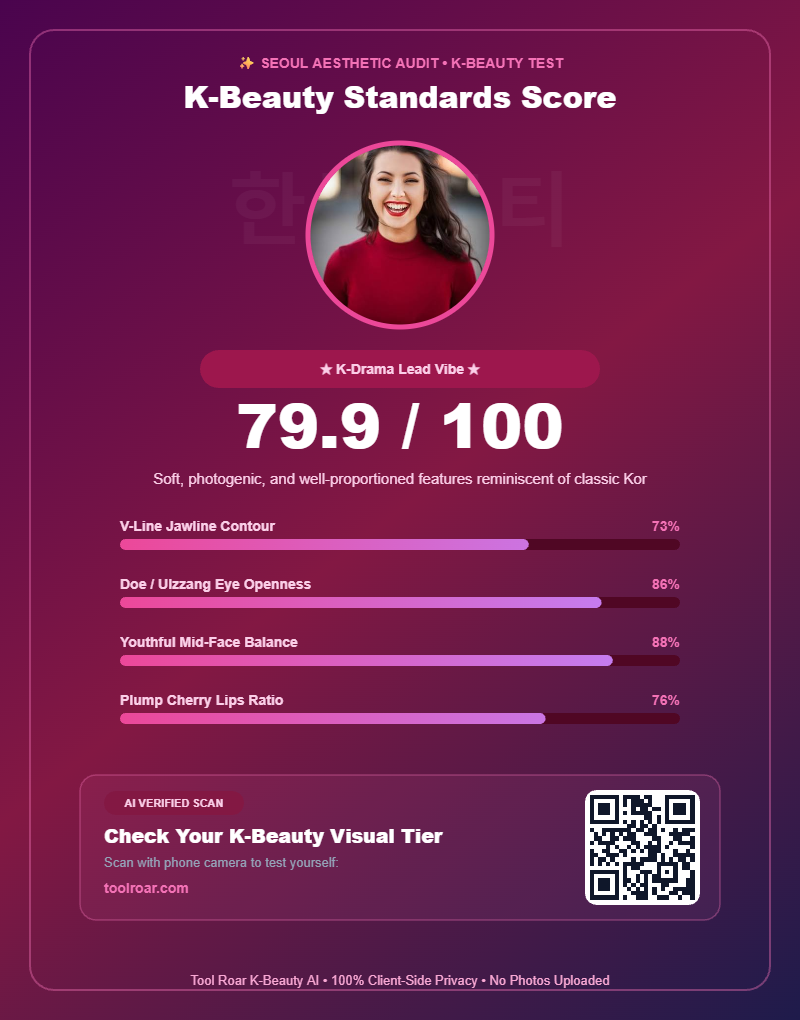
For a more useful comparison, use a photo with consistent lighting, a relatively straight-on angle, and a neutral expression. Avoid comparing results from photographs taken under very different conditions.
How to Get a More Consistent Result
The quality of a photo can affect the facial features that an automated system detects. A few simple adjustments can make your test experience more consistent.
- Face the camera directly. Strong side angles can change the apparent outline of your jaw and the relative positions of facial features.
- Use even lighting. Harsh shadows can make one side of the face appear different from the other.
- Keep your face unobstructed. Hair, hands, large accessories, and other objects may cover important areas.
- Use a natural expression. Smiling, squinting, or raising your eyebrows can change how some features appear.
- Avoid strong filters. Beauty filters can alter the apparent shape, proportions, and texture of facial features.
- Use a reasonably sharp image. Blurry photos may make facial landmarks more difficult to detect.
These steps can help reduce unnecessary variation, but they cannot guarantee an accurate or scientifically validated beauty score.
What Does Your Korean Beauty Score Mean?
Your result represents how the tool’s scoring model evaluates the four selected feature groups against its built-in targets. It should not be interpreted as a universal measure of attractiveness or as an official assessment of Korean beauty standards.
A higher score does not mean someone is inherently more attractive, and a lower score does not mean someone needs to change their appearance. The result is influenced by the features the tool measures, the weights assigned to them, the selected mode, and the quality of the uploaded photo.
It is also important to distinguish between a tool’s internal score and scientific validation. A score can be calculated consistently without proving that the underlying targets accurately represent the preferences of a population.
Use the result as a way to learn about the tool’s selected facial proportions, not as a reason to feel pressured to match a particular look.
Korean Beauty Trends Versus Individual Beauty
K-beauty includes much more than facial proportions. Skincare, personal styling, makeup techniques, hair, fashion, and individual expression all play a role in how someone presents themselves.
Popular celebrity aesthetics can make certain features more visible in media, but celebrity styling is not a universal standard. Makeup artists, lighting, camera lenses, editing, and professional photography can also change how a face appears.
Furthermore, beauty ideals evolve. A feature that is fashionable in one period or community may not receive the same emphasis in another. People can appreciate Korean beauty trends without assuming that every Korean person follows the same preferences or that everyone should aim for the same facial structure.
The most useful approach is to treat beauty trends as sources of inspiration. You can explore a makeup style, hairstyle, or skincare routine because you enjoy it, without treating an automated score as a requirement.
Is the Korean Beauty Standards Test Accurate?
The tool provides an automated estimate based on its predefined feature weights and target proportions. Its score should not be confused with a validated psychological survey, a clinical facial assessment, or a representative study of Korean beauty preferences.
Several limitations are worth keeping in mind:
- Limited feature selection: Four categories cannot represent the full range of factors that influence beauty preferences.
- Photo dependence: Lighting, angle, expression, and image quality may affect the features detected.
- Predefined targets: The result depends on the proportions and scoring rules built into the tool.
- Cultural variation: Beauty preferences differ among people and communities, including within the same country.
- No universal benchmark: There is no single numerical score that establishes whether a person meets a universal Korean beauty standard.
The test is best suited to casual exploration and understanding how a simplified facial scoring system works. It should not be used to make health decisions or determine whether cosmetic procedures are necessary.
Korean Beauty Standards Test vs. Other Face Analysis Tools
Different facial analysis tools answer different questions. Choosing the right one depends on what you want to explore.
- Korean Beauty Standards Test: Examines selected features inspired by K-beauty trends, including jaw contour, eye openness, mid-face ratio, and lip fullness.
- AI Golden Ratio Face Calculator: Explores selected facial proportions through a golden-ratio-inspired scoring model.
- AI Face Shape Detector: Estimates a face-shape category, such as oval, round, square, heart, diamond, or oblong.
- Facial Symmetry Checker: Examines selected aspects of left-to-right facial alignment, including the eyes, eyebrows, jawline, and mouth.
These tools measure different things. A face-shape result does not tell you your Korean beauty score, and a symmetry score does not establish whether your facial proportions match a particular aesthetic trend.
Frequently Asked Questions
Is the Korean Beauty Standards Test free to use?
Check the Tool Roar test page for the current access details. The tool is designed to let users explore selected facial characteristics through an online photo-based experience.
What features does the test analyze?
The scoring model uses four factors: V-line jaw contour (35%), eye openness (25%), mid-face ratio (20%), and lip fullness (20%). Learn how an AI face shape detector classifies facial shapes.
Why does the test have male and female modes?
The available modes adjust the target ratios used by the scoring model. This is a design choice within the tool and does not mean all men or all women share the same facial proportions or beauty preferences. Explore facial proportions with a golden-ratio-inspired calculator.
Does a high score mean I meet Korean beauty standards?
Not necessarily. The result reflects the tool’s predefined scoring model, not an official national standard or a survey of what Korean people find attractive.
Can makeup affect my score?
It may. Makeup, filters, shadows, and strong changes in facial appearance can influence how features look in a photograph and may affect automated analysis. Check facial alignment with an AI symmetry tool.
Should I change my appearance based on my score?
No. The result is intended for curiosity and entertainment, not as a recommendation for cosmetic treatments or a judgment of your appearance. Any personal styling choices should be based on your own preferences and comfort.
Is this test a scientific measure of attractiveness?
The score is generated by a predefined model, but that alone does not establish scientific validity. It should not be treated as a validated measure of attractiveness or as evidence of a universal beauty standard.
1 thought on “Korean Beauty Standards Test – Check K-Beauty Score – 2026”