
AI Face Symmetry Checker
Tilt-normalized bilateral paired landmark analysis to measure symmetry across your jawline, eyes, brows, and mouth.
Auto-corrects head tilt for accurate bilateral measurement
Calculating bilateral landmark symmetry...
Have you ever noticed that one eyebrow sits slightly higher than the other, one side of your smile looks different, or your jawline appears a little uneven in photographs? These small differences are common, but they can be difficult to evaluate when you look at your face every day.
A facial symmetry checker offers a way to explore these differences using a photograph. Instead of relying entirely on your own visual impression, you can use a facial analysis tool to examine selected features on the left and right sides of your face.
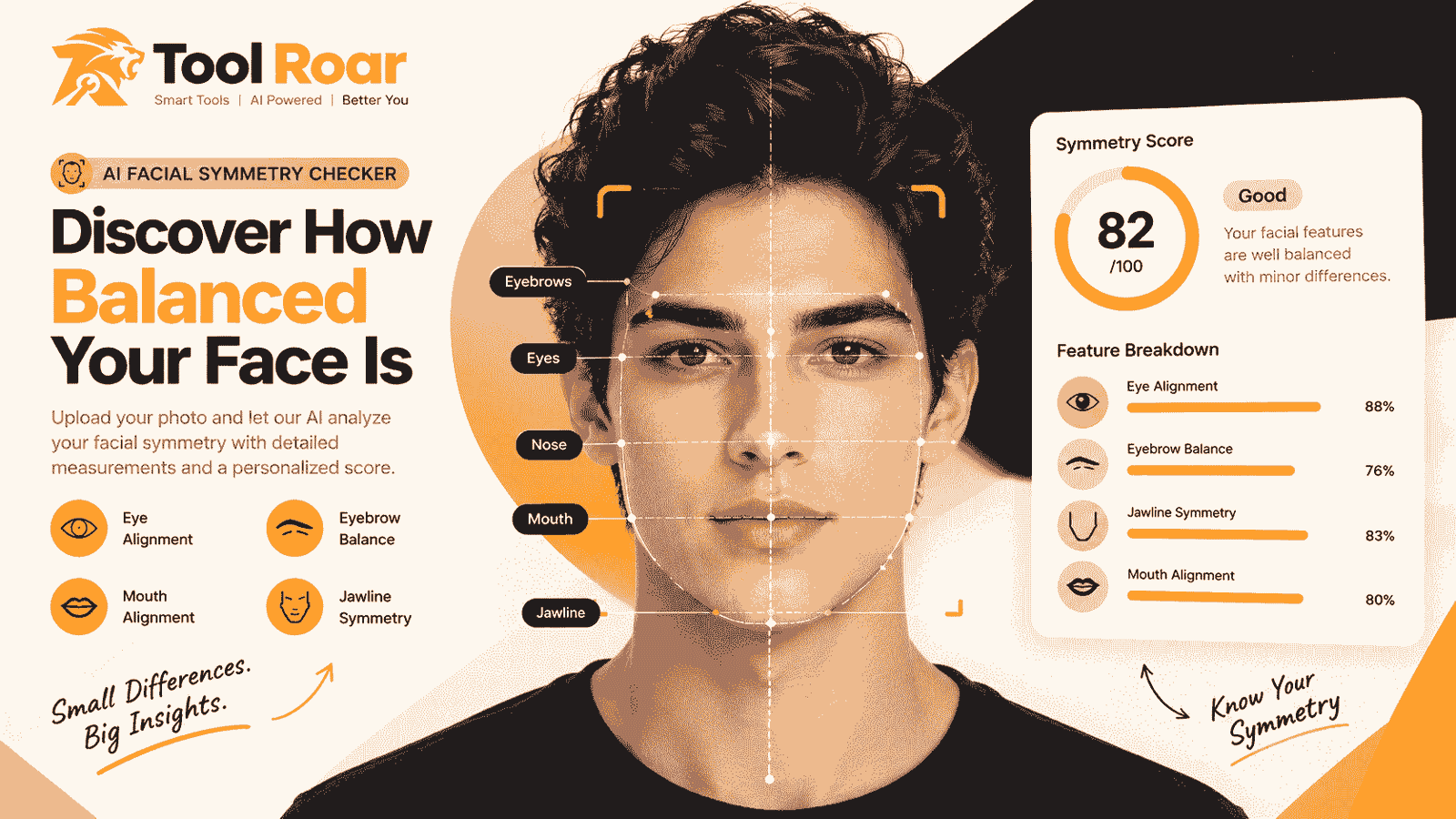
Tool Roar’s AI Face Symmetry Checker is designed to make this process simple. It analyzes selected facial landmarks and produces a score based on eye alignment, jawline symmetry, eyebrow balance, and mouth alignment.
The result can help you understand how facial symmetry is measured and which features contribute to the analysis. It is not a medical assessment or a definitive measure of attractiveness. Human faces naturally have differences between their two sides, and a numerical score cannot capture every aspect of facial appearance.
In this guide, you will learn how to check facial symmetry online, what the main measurements mean, how to interpret your result, and why small facial differences are not necessarily something to correct.
Table of Contents
What Is Facial Symmetry?
Facial symmetry describes how closely the corresponding features on the left and right sides of a face resemble one another around an imaginary central line.
Imagine drawing a vertical line from the middle of your forehead, through the center of your nose, toward your chin. This line provides a simple reference for comparing the positions of paired features, such as the eyes, eyebrows, and sides of the jaw.
If corresponding features occupy similar positions and have similar shapes, the face may appear more symmetrical in those areas. Differences in height, width, angle, or position contribute to facial asymmetry.
However, symmetry does not mean that every feature must be identical. Natural faces commonly have small differences, and those variations may be difficult to notice in everyday interactions.
Facial symmetry is also different from facial proportions. Proportions describe relationships between measurements, while symmetry focuses on differences between corresponding features on opposite sides.
For example, a face may have balanced left and right eye positions without matching a particular golden ratio. Similarly, someone can have a clearly recognizable face shape while showing small differences between their eyebrows or jawline.
What Is an AI Facial Symmetry Checker?
An AI facial symmetry checker is an online tool that uses facial analysis to estimate how balanced selected facial features appear in a photograph.
The process generally involves detecting facial landmarks, identifying corresponding points, and comparing their relative positions. The results can then be summarized through measurements or a custom symmetry score.
Tool Roar’s AI Face Symmetry Checker focuses on four components:
- Eye alignment: Examines the relative positioning of the eyes.
- Jawline symmetry: Evaluates differences in the visible jawline.
- Eyebrow balance: Compares the alignment of the eyebrows.
- Mouth alignment: Examines the positioning of the mouth.
The calculator combines these components using predefined weights to produce an overall result.
This provides a convenient introduction to facial symmetry analysis without requiring specialized measurement equipment. However, the score reflects the tool’s own calculation method rather than a universally standardized clinical measurement.
How to Check Your Facial Symmetry Online
You can explore your facial symmetry with Tool Roar in a few simple steps.
Step 1: Open the AI Face Symmetry Checker
Visit the AI Face Symmetry Checker on Tool Roar and open the tool interface.
Step 2: Choose a Suitable Photograph
Upload a clear, front-facing photograph in which both eyes, eyebrows, cheeks, and the jawline are visible.
A straight-on portrait is generally more suitable than a selfie taken from above, below, or at an angle. Keep your head in a natural position and avoid strong shadows across one side of your face.
Step 3: Run the Facial Analysis
Start the analysis and allow the tool to detect the facial landmarks needed for its calculations.
The tool evaluates the selected features and compares their relative positions. The quality of the detected landmarks can influence the resulting measurements.
Step 4: Review the Symmetry Score
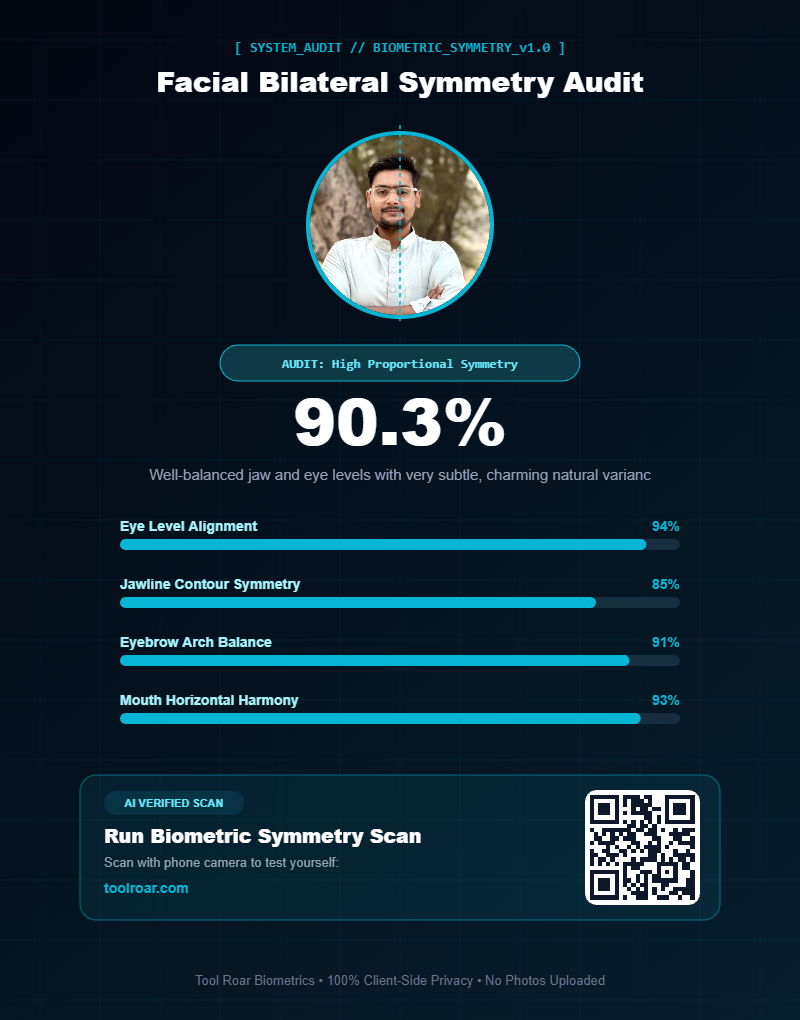
Once the analysis is complete, examine the overall result and the individual component scores presented by the calculator.
Instead of focusing only on the final number, consider which features contribute to the result. This can help you understand what the tool is measuring and download the scoreboard
Step 5: Interpret the Result as an Estimate
Use the output as an informational reference, not as a diagnosis or a judgment of your appearance.
If the result seems unusual, try a second clear photograph with more even lighting and a straighter head position. A difference between two results may reflect changes in the photographs rather than a physical change in your face.
How Does Tool Roar’s Face Symmetry Checker Calculate the Score?
The calculator uses four weighted components. Each component contributes a specific proportion to the overall score.
1. Eye Alignment: 30%
Eye alignment accounts for 30% of the calculator’s weighted score.
The tool examines the relative positions of the eyes to estimate how balanced they appear. Differences in eye height or alignment may affect this component.
However, the apparent position of the eyes can change with head tilt, camera perspective, and facial expression. A photograph-based estimate should therefore not be treated as an exact measurement of the underlying facial structure.
2. Jawline Symmetry: 30%
Jawline symmetry contributes another 30%.
This component evaluates selected measurements associated with the visible left and right sides of the jawline. Differences in contour or relative positioning can affect the result.
The jawline can be difficult to assess when it is hidden by hair, facial hair, shadows, or an angled photograph. These factors may influence the landmarks detected by the tool.
3. Eyebrow Balance: 20%
Eyebrow balance contributes 20% of the overall score.
The calculator compares the positioning of the eyebrows to estimate their relative alignment. One eyebrow may naturally sit higher or have a different arch from the other.
Eyebrow grooming, facial expression, and forehead movement can also change how balanced the eyebrows appear in a photograph.
4. Mouth Alignment: 20%
Mouth alignment contributes the remaining 20%.
This component examines the position of the mouth and selected visible features around it. Differences in the height or angle of the mouth can influence the calculation.
A smile can change the appearance of the lips and mouth corners. For a more consistent comparison, use a photograph with a relaxed, natural expression.
Understanding the Weighted Formula
The calculator’s component weights are summarized below.
| Facial component | Weight |
|---|---|
| Eye alignment | 30% |
| Jawline symmetry | 30% |
| Eyebrow balance | 20% |
| Mouth alignment | 20% |
| Total | 100% |
These weights describe how the Tool Roar calculator combines its components. They do not mean that a face with a particular score has that exact percentage of anatomical symmetry.
The score is a simplified output from the tool’s predefined formulas. It should not be interpreted as a clinical asymmetry measurement or as a validated attractiveness rating.
What Does Your Facial Symmetry Score Mean?
Your result is best understood as an estimate of how closely selected facial measurements match the calculator’s symmetry targets.
A higher score indicates a closer match according to the tool’s scoring rules. A lower score suggests greater differences in the measurements evaluated by the calculator.
Neither result automatically means that your face is attractive or unattractive, healthy or unhealthy, or in need of treatment.
For example, a person might receive a lower score because one eyebrow appears higher in the uploaded photograph. That observation does not establish that the underlying facial structure is abnormal. It may reflect a natural feature, an expression, a camera angle, or an imperfect landmark detection.
The individual component measurements can be more informative than the headline number because they show which features contributed to the result.
There is also an important distinction between a calculator’s score and a professionally measured facial asymmetry value. Clinical assessments may use standardized photographs, physical examinations, dental records, or three-dimensional imaging, depending on the purpose of the evaluation.
A simple online photograph analysis cannot replace those methods.
Is Facial Asymmetry Normal?
Yes. Mild facial asymmetry is common in the general population.
The two sides of a human face do not develop as perfectly identical mirror images. Differences may appear in eyebrow height, eye position, cheek contours, the jawline, or the shape of the mouth.
A review published in the Dental Press Journal of Orthodontics explains that mild facial asymmetry is common and often occurs without noticeable clinical problems. More pronounced asymmetry can have different causes and may require professional assessment when it affects function or causes concern.
You can read the review, Facial asymmetry: a current review, for a more detailed explanation of how facial differences are evaluated in clinical settings.
The important point is that detecting a small difference does not automatically identify a problem. Facial symmetry tools can describe selected visible features, but they cannot determine the medical significance of an asymmetry from a score alone.
Does a More Symmetrical Face Always Look Better?
Not necessarily. Facial symmetry is one of many characteristics that may influence how a face is perceived, but it does not determine attractiveness on its own.
Research into facial appearance examines several factors, including overall facial shape, individual features, expression, and the methods used to measure symmetry.
For example, a 2020 study published in Personality and Individual Differences highlighted limitations in conventional facial asymmetry scores, including the influence of head pose. This illustrates why image positioning and measurement methods matter when interpreting a symmetry result.
You can read the study, Symmetric or not? A holistic approach to the measurement of fluctuating asymmetry from facial photographs.
A face symmetry score is therefore not a complete assessment of facial attractiveness. It describes selected geometric relationships rather than the full experience of how a person looks.
Why Can Your Face Look Uneven in Photos?
Sometimes, facial differences seem more noticeable in a photograph than they do in a mirror. Several factors can explain this.
Camera Angle and Head Position
A camera positioned above, below, or to one side of your face can change the apparent relationship between facial features.
Even a small head tilt may make the eyes or eyebrows appear uneven. Since symmetry calculations depend on relative positions, camera angle can influence the result.
Lighting and Shadows
Light falling more strongly on one side of the face can make its contours appear different from those on the other side.
Shadows around the eyes, nose, and jawline can also make facial boundaries harder to identify.
Facial Expression
Smiling, squinting, raising an eyebrow, or tightening the jaw can change the visible position of facial features.
A photograph taken while speaking or smiling may therefore produce different measurements from a relaxed portrait.
Lens Perspective
Close-up selfies can exaggerate some features relative to others because of perspective. This is especially relevant when the camera is very close to the face.
Taking a photograph from a comfortable distance with the camera approximately at eye level can provide a more consistent starting point.
Facial Hair, Hair, and Obstructions
Hair covering the jawline, glasses obscuring the eye area, or shadows hiding facial boundaries may interfere with landmark detection.
A clear photograph makes it easier for the calculator to identify the features it needs to measure.
Tips for Getting a More Consistent Symmetry Analysis
For a useful comparison, try to keep the photograph as consistent as possible.
- Face the camera directly. Keep your head upright and avoid turning it to either side.
- Use even lighting. Choose a well-lit setting without strong shadows.
- Keep both sides visible. Make sure your hair does not cover the eyes, eyebrows, or jawline.
- Use a relaxed expression. Avoid exaggerated smiles, squinting, or raised eyebrows.
- Avoid beauty filters. Filters may alter facial contours or the apparent position of features.
- Choose a clear image. Blurry photographs can make facial landmark detection less reliable.
- Avoid very close selfies. A little distance can reduce perspective distortion.
These tips can improve the consistency of the input photograph, but they cannot guarantee a particular score or eliminate all measurement errors.
When Should You Seek a Professional Assessment?
A facial symmetry checker is intended for general informational use. It cannot diagnose facial conditions or determine whether treatment is necessary.
If you have concerns about jaw function, bite alignment, persistent facial discomfort, or a noticeable structural difference, a qualified healthcare professional can assess the issue in context.
Seek urgent medical attention if facial asymmetry appears suddenly, particularly when accompanied by facial weakness, difficulty speaking, or weakness in an arm or leg. These symptoms can indicate a medical emergency and should not be evaluated with an online beauty tool.
An online score should never delay appropriate medical care.
Frequently Asked Questions
How can I check my facial symmetry online?
You can use Tool Roar’s AI Face Symmetry Checker. Upload a clear, front-facing photograph and review the estimated alignment of your eyes, jawline, eyebrows, and mouth.
What is a good facial symmetry score?
There is no universal score that defines a perfect or medically normal face. Tool Roar’s result reflects its own scoring formula and should be interpreted as an informational estimate.
Is a facial symmetry checker accurate?
Its reliability depends on photograph quality, landmark detection, camera angle, and the calculations used. The tool provides an estimate rather than a clinically validated assessment of facial symmetry.
Why is one side of my face different from the other?
Small differences between the two sides of the face are common. They may relate to natural development, facial expression, or how the face appears in a photograph. An online calculator cannot determine the cause of a particular difference.
Can a selfie affect my symmetry score?
Yes. Head tilt, close-up perspective, lighting, and facial expression can change the apparent positions of facial features. A straight-on photograph can help make comparisons more consistent.
Does facial symmetry determine attractiveness?
No. Symmetry is only one aspect of facial appearance, and attractiveness cannot be reduced to a single score or measurement.
Can I make my face perfectly symmetrical?
Perfect bilateral facial symmetry is not a realistic requirement for normal human appearance. Styling, photography, and grooming can change how features appear, but a calculator cannot prescribe a treatment for structural differences.
Is an online face symmetry test a medical assessment?
No. It is an informational tool that estimates selected features from a photograph. Clinical concerns require an appropriate professional assessment.
Explore Your Facial Symmetry With Tool Roar
Curious about how balanced your facial features appear in a photograph?
Try Tool Roar’s AI Face Symmetry Checker to explore eye alignment, jawline symmetry, eyebrow balance, and mouth alignment in one convenient analysis.
Upload a clear photo, review the component results, and learn how different facial measurements contribute to the overall score.
Remember that natural facial differences are common, and a symmetry score does not define your appearance or personal worth. Use the result as a learning tool rather than a standard you must meet.
Also Check AI Golden Ratio Face Calculator
2 thoughts on “AI Facial Symmetry Checker – Analyze Your Face Online – 2026”