
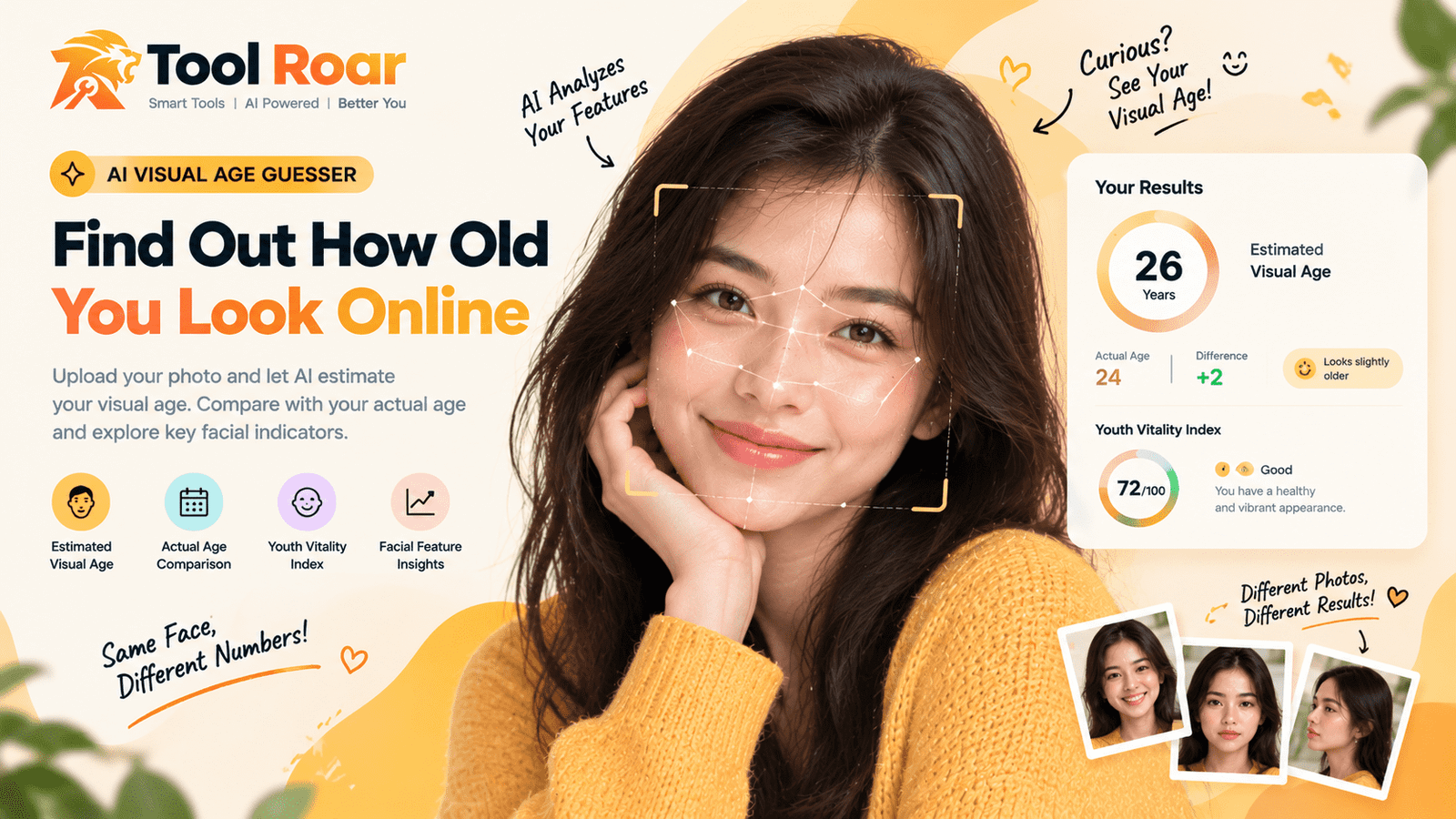
AI Visual Age Guesser
Find out how old you look to an advanced AI neural network based on facial volume, skin tone, and bone structure.
Upload a natural photo with good lighting
Analyzing skin texture & facial age markers...
Have you ever looked at a photo and wondered whether you appear younger or older than your actual age? Lighting, facial expressions, skin texture, and other visible details can change how old someone appears in a picture.
The AI Visual Age Guesser on Tool Roar lets you explore this question using a photo. It uses an AI model to estimate visual age and provides related information, including an optional comparison with your actual age and a Youth Vitality Index.
The result is an estimate based on visible features, not a measurement of your biological age. You can use the tool out of curiosity, compare different photos, or learn how AI makes predictions from facial images.
Table of Contents
What Is an AI Visual Age Guesser?
An AI Visual Age Guesser is an online tool that estimates how old a person appears based on a facial photo. Instead of asking how old you are, it analyzes patterns in the image and produces an estimated visual age.
For example, you might be 30 years old but receive an estimated visual age of 27. That does not mean your body is biologically three years younger. It simply means the model’s prediction from that photo was 27.
Tool Roar’s AI Visual Age Guesser also offers an optional actual-age input so you can compare your age with the model’s estimate. The tool may display additional results, such as a Youth Vitality Index, to help you explore the output.
How Does AI Estimate Your Visual Age?
AI age estimation models learn patterns from facial images that have been associated with age information during training. When you provide a photo, the model analyzes the visible facial information and generates an estimate.
Several things can influence the result, including:
- Skin texture: Visible lines, texture, and other details may contribute to age-related patterns learned by the model.
- Facial appearance: The overall appearance of facial features can influence the prediction.
- Expression: Smiling, frowning, or relaxing your face can change how certain details appear. Learn how our Facial Symmetry Checker analyzes facial alignment.
- Photo quality: Blur, shadows, lighting, and camera angle can affect the information available to the model.
The tool does not know your full life history, genetics, health, or lifestyle from a single photo. It makes a prediction from the image, and that prediction can be wrong.
How to Use Tool Roar’s AI Visual Age Guesser
Using the tool is straightforward.
- Open the tool: Visit the AI Visual Age Guesser page on Tool Roar.
- Choose a clear photo: Select an image where your face is visible and reasonably well lit.
- Upload your image: Follow the instructions shown on the tool page.
- Enter your actual age if you wish: If the optional field is available, provide your age to compare it with the visual-age estimate.
- Run the analysis: Let the model process the image.
- Review your results: Check the estimated visual age, the comparison with your actual age if provided, and any additional indicators displayed.
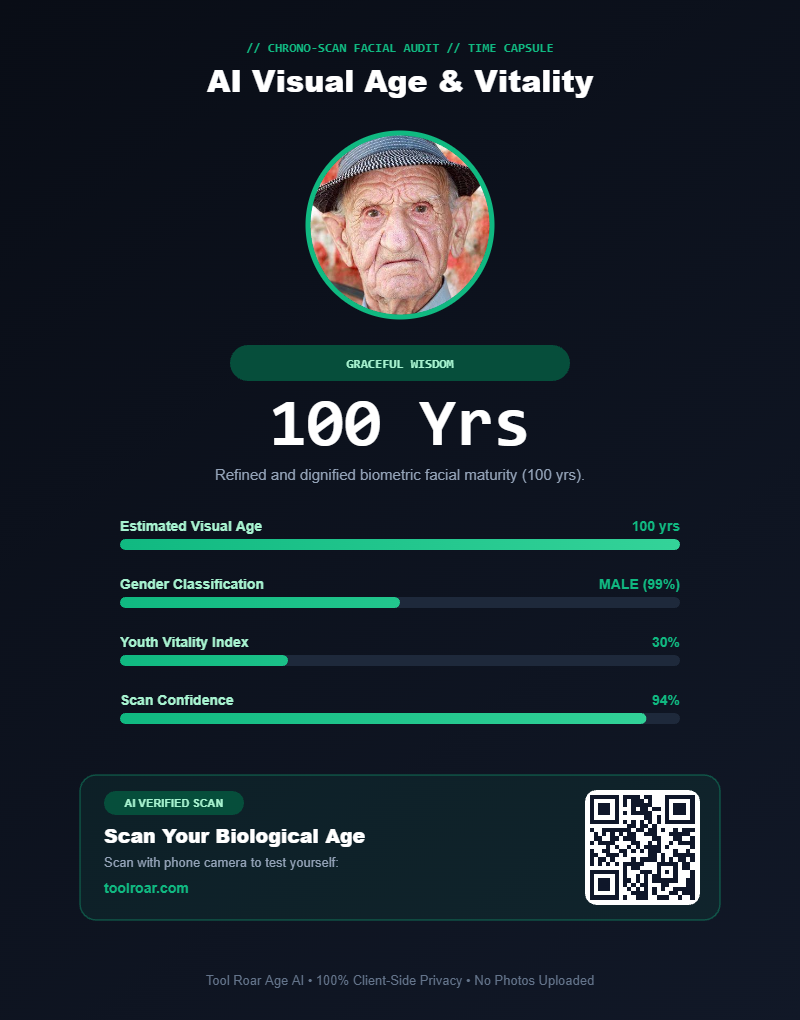
For a fairer comparison between photos, try to use similar lighting, camera distance, and facial expressions.
Visual Age vs. Actual Age: What’s the Difference?
These two numbers answer different questions.
Actual age is the amount of time that has passed since your birth. Visual age is an estimate of how old you appear in a particular image according to the model.
Imagine someone is 35 years old and the tool estimates their visual age as 31. The difference is four years, but it does not establish that the person is healthier, younger biologically, or ageing more slowly than someone else.
A different photo might produce a different estimate. A harsh overhead light could emphasize facial texture, while soft lighting might make the same features appear less pronounced. Expression and camera angle can also change the result.
This is why visual age is best understood as a photo-based estimate rather than a permanent label.
What Does the Youth Vitality Index Mean?
Tool Roar includes a Youth Vitality Index as an additional indicator in its age-analysis experience. It is intended to provide another way to explore the result alongside the estimated visual age.
However, a vitality score generated from a facial image should not be confused with a medical measurement of vitality, fitness, physical health, or biological ageing. A face photo cannot provide a complete assessment of those things. Find your estimated face shape with our AI Face Shape Detector.
If you receive a high or low index, treat it as a result produced by the tool’s model. It should not be used to diagnose a condition, assess your health, or decide whether you need medical care.
Why Can the Same Person Get Different Age Estimates?
It is possible to receive different estimates from different photos of yourself. This does not necessarily mean that your appearance has changed significantly.
Consider these common situations:
- Different lighting: Bright or directional light can emphasize some facial details while hiding others.
- Different expressions: A smile may change the shape of your cheeks and the appearance of lines around your eyes.
- Different camera angles: A photo taken from above, below, or at an angle may present facial features differently.
- Filters and editing: Beauty filters can smooth skin or change facial details, affecting what the model sees.
- Different image quality: A sharp image provides different visual information from a compressed or blurry one.
For the most useful comparison, take photos under similar conditions and avoid filters. Even then, small differences in the estimate are possible.
Tips for Getting a More Consistent Result
You do not need a professional camera to try the tool. A few simple steps can help you provide a clearer image.
- Use even lighting. Choose a bright location where your face is visible without strong shadows.
- Face the camera naturally. A straightforward angle makes it easier to compare photos consistently.
- Keep your face unobstructed. Avoid sunglasses, hands covering your face, or hair hiding large areas. Explore facial proportions with our AI Golden Ratio Face Calculator.
- Avoid beauty filters. Filters can change skin texture and facial details, making the result less representative of your unedited appearance.
- Use a clear image. Blurry, very small, or heavily compressed photos may affect the analysis.
- Compare like with like. If you test multiple images, try to keep the camera position, lighting, and expression similar.
These tips can improve consistency, but they cannot guarantee that the estimated age will match your actual age.
Is an AI Face Age Estimator Accurate?
An AI model can generate an age estimate, but it should not be expected to identify someone’s age perfectly from every photo.
Its performance depends on the model, its training data, the image quality, and how closely the photo resembles the examples the model learned from. Results may vary across individuals and image conditions.
It is also important to distinguish between a displayed confidence figure and independently verified accuracy. A percentage shown by a tool does not automatically mean that the prediction is correct that often in real-world use. Unless a model has been independently evaluated under appropriate conditions, its displayed output should not be treated as a guarantee.
Use Tool Roar’s result as an estimate for curiosity, not as proof of your age or a scientific measure of how well you are ageing.
Is the AI Visual Age Guesser a Health Test?
No. An AI visual age estimate is not a medical assessment.
A person’s appearance is influenced by many factors, and a facial photograph cannot reliably establish their biological age, internal health, or life expectancy. Someone who looks older in a photo is not necessarily unhealthy, and someone who looks younger is not necessarily healthier.
If you have concerns about your skin or health, seek advice from an appropriately qualified healthcare professional rather than relying on a face-age score. The tool is better suited to casual experimentation and understanding how an AI model interprets a photo.
Frequently Asked Questions
How old do I look according to AI?
An AI age estimator analyzes a photo and predicts an approximate visual age. You can try Tool Roar’s AI Visual Age Guesser to explore its estimate, but the result may differ from your actual age.
Is visual age the same as biological age?
No. Visual age describes how old you appear in an image according to an estimate. Biological age is a different concept and cannot be reliably determined from a face photo alone.
Can I compare my visual age with my actual age?
Yes. Tool Roar’s tool provides an optional actual-age input so you can compare your age with the model’s estimate.
Why does my estimated age change between photos?
Lighting, facial expression, camera angle, image quality, and other visible differences can influence the model’s prediction.
Does a younger visual age mean I am healthier?
No. A younger estimate does not prove better health, slower biological ageing, or greater vitality. The result is based on facial-image analysis.
Does the tool guarantee an accurate result?
No. AI age estimation can produce incorrect results, and the quality of the image and the model’s limitations can affect the output.
Can I use a filtered selfie?
You can follow the tool page’s image instructions, but filters may alter facial features and affect the estimate. An unfiltered photo is a better choice if you want to explore how your face appears naturally.
Also Check AI Smile & Emotion Analyzer
Also Check Korean Beauty Standards Test