
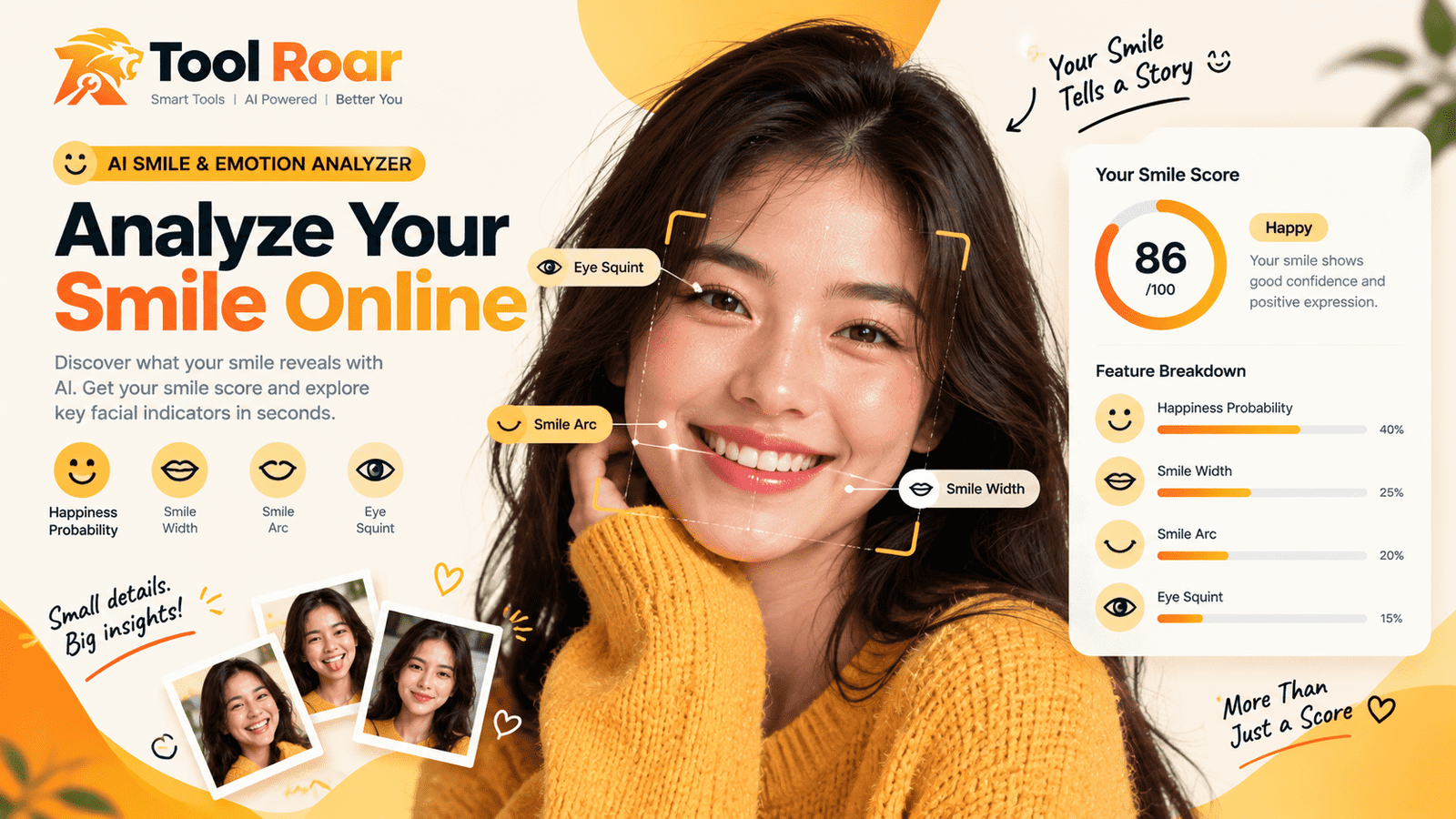
AI Smile & Emotion Analyzer
Evaluates your smile arc, teeth & lip width, and distinguishes a genuine Duchenne smile from a polite camera-ready smile.
Upload a photo showing your smile
Analyzing smile arc & Duchenne eye crinkles...
A smile can look different from one photo to another. Sometimes your smile is wide and obvious; other times, it is subtle. Your eyes, mouth shape, and facial expression can all change how a smile appears in a picture.
The AI Smile & Emotion Analyzer on Tool Roar helps you explore these visible features in a photo. It combines several indicators, including estimated happiness probability, smile width, smile arc, and eye squint, to produce an overall result.
You can use it to explore how your smile appears in a selfie, compare different expressions, or simply learn how an AI tool analyzes facial cues. However, it is important to understand one thing: a photo can show visible signs of smiling, but it cannot reliably reveal everything a person is feeling.
Table of Contents
What Is an AI Smile & Emotion Analyzer?
An AI Smile & Emotion Analyzer is an online tool that examines visible facial cues associated with smiling and certain expressions. Rather than looking only at whether your mouth is open or curved upward, the Tool Roar analyzer combines several indicators into a single result.
This can make the experience more interesting than a simple smile detector. You can explore how the mouth and eyes contribute to the appearance of a smile and see how the tool’s scoring model combines those signals.
The tool is intended for casual use and facial-expression exploration. It is not a psychological assessment, a medical test, or a reliable way to determine someone’s true emotions.
What Does the Tool Analyze?
Tool Roar’s analyzer combines four indicators. Each one contributes a different amount to the overall score.
1. Happiness Probability – 40%
This is the largest component of the tool’s score. It represents the model’s estimate of how strongly the detected facial expression resembles a happy expression.
A higher estimate does not prove that someone feels happy. People may smile when they are nervous, being polite, posing for a photograph, or experiencing mixed emotions. Likewise, someone can feel happy without showing a broad smile.
Think of this result as an estimate of visible expression, not a reading of someone’s inner feelings.
2. Smile Width – 25%
Smile width looks at how broad the smile appears. A wider smile may be more visually noticeable, while a smaller smile can look subtle or relaxed.
But a wide smile is not automatically better than a small one. Natural mouth shape, facial structure, camera angle, and the way someone smiles all influence this measurement.
The tool gives smile width a 25% contribution to its combined score. This is a design choice in its scoring model, not evidence that smile width accounts for a particular percentage of real-world happiness.
3. Smile Arc – 20%
The smile arc relates to the curve formed by the mouth when smiling. The shape of this curve can differ from person to person and between expressions.
The analyzer uses smile arc as another signal in its scoring process. It is only one part of the result, so it should not be treated as a standard that every smile needs to match.
Your natural smile may have a different curve and still look genuine, warm, or expressive.
4. Eye Squint – 15%
A smile can involve changes around the eyes as well as the mouth. For example, the cheeks may rise and the eyes may narrow slightly during some smiles.
The tool includes eye squint as a 15% component. However, narrowed eyes can also result from bright lighting, a deliberate pose, tiredness, or individual facial characteristics. Some genuine smiles do not produce an obvious eye squint.
That is why this indicator should be interpreted alongside the other measurements, rather than used on its own to decide whether a smile is genuine.
How to Use the AI Smile & Emotion Analyzer
You can try the tool with a suitable photo in a few simple steps.
- Open the tool. Visit Tool Roar’s AI Smile & Emotion Analyzer page.
- Choose a clear photo. Use an image in which your face is visible and your mouth and eyes are not covered.
- Follow the on-screen instructions. Upload or select your image as supported by the tool.
- Review the result. Look at the overall score and the individual indicators provided.
- Try another expression if you want to compare. For a more meaningful comparison, use photos taken under similar conditions.
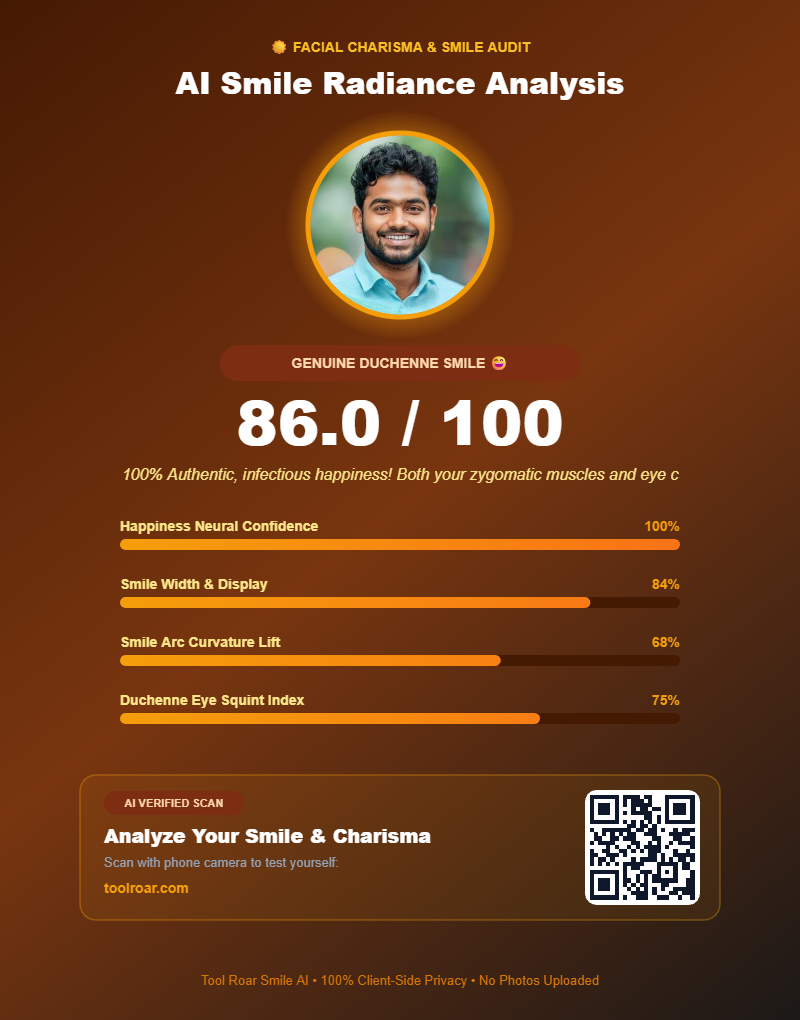
A photo with a clear view of the face gives the analyzer a better opportunity to detect the relevant features. Results can still vary, and the tool does not guarantee a scientifically accurate interpretation of emotion.
How to Get a More Useful Result
If you want to compare how different smiles appear, try to keep the photo conditions similar.
- Use even lighting. Strong shadows can make parts of your mouth or eyes harder to assess.
- Keep your face visible. Hands, hair, sunglasses, or other objects may hide important features.
- Avoid extreme camera angles. A photo taken from far above or below can change the apparent shape of your smile.
- Use a reasonably sharp image. Blurry images can make facial details harder to detect.
- Try different expressions naturally. You can compare a subtle smile with a broad one without forcing an expression.
- Be careful with filters. Beauty filters and editing can alter the appearance of your mouth, cheeks, and eyes.
These suggestions help you explore the tool more consistently. They do not guarantee that the score will accurately reflect your emotional state.
Can AI Tell Whether a Smile Is Genuine?
Not with certainty from a single photo.
An AI system can identify visual patterns that are commonly associated with particular facial expressions. But a facial expression is not the same thing as an emotion. A smiling face does not always mean happiness, and a neutral face does not necessarily mean sadness or a lack of interest.
Context matters. The same expression may have different meanings depending on the situation, the person, and what happened before the photo was taken. A still image also misses changes in expression over time, tone of voice, and other useful information.
For these reasons, Tool Roar’s analyzer should not be used to judge whether a friend, partner, employee, customer, or stranger is being honest or hiding an emotion. It is better suited to exploring visible smile features for personal curiosity.
Why Can Your Score Change Between Photos?
If you test two photos of yourself and receive different results, it does not necessarily mean that anything about you has changed. The images may simply show your facial features differently.
For example, a broad smile may increase the detected smile width, while a more relaxed expression may produce a different result. Lighting can affect the visibility of the eyes, and a slight head turn can change how the mouth appears.
The model’s happiness estimate may also respond differently to two expressions. Because the score combines multiple indicators, changes in one or more components can affect the final result.
If you are comparing photos, try to use similar lighting, camera distance, and head position. Treat small score differences cautiously rather than assuming that one photograph reveals more happiness or a more genuine personality than another.
Who Can Use This Tool?
The AI Smile & Emotion Analyzer may be useful for:
- Curious users who want to explore how AI analyzes facial expressions.
- Content creators who want to compare how different smiles appear in photographs.
- Photography enthusiasts who are interested in expression and portrait presentation.
- Students and technology learners who want a simple introduction to facial-expression analysis.
It should not be used for hiring decisions, mental health diagnosis, lie detection, or other high-stakes judgments about people. A smile score is not enough evidence to make those decisions.
When testing photos of other people, respect their privacy and obtain permission where appropriate.
Frequently Asked Questions
Is the AI Smile & Emotion Analyzer free?
Yes, the AI Smile and Emotion Analyzer is absolutely free to use and accesible to everyone.
What does the happiness probability mean?
It is the model’s estimate based on visible facial cues associated with a happy expression. It does not measure a person’s actual emotional state or prove that they feel happy.
Does a higher smile score mean I have a better smile?
No. The score reflects the tool’s predefined scoring model. It is not an objective rating of attractiveness, personality, or how much other people enjoy your smile.
Why does the tool check the eyes as well as the mouth?
Some smiles involve visible changes around the eyes as well as the mouth. Eye squint is included as one indicator, but it can be affected by lighting, facial differences, and other factors.
Can I use the tool to check someone else’s emotions?
You can explore visible expression cues, but you should not treat the result as proof of what another person feels. A photograph cannot provide a complete or reliable account of someone’s emotional state.
Will the same photo always produce the same score?
The result depends on the tool’s analysis and the features detected in the image. If you receive a score, treat it as an estimate from that particular analysis, not as a permanent description of your smile.
Also Check Korean Beauty Standards Test
Also Check AI Facial Symmetry Checker
Also Check AI Face Shape Detector
Also Check AI Golden Ratio Face Calculator